To learn more about the benefits of becoming a member, please click here.
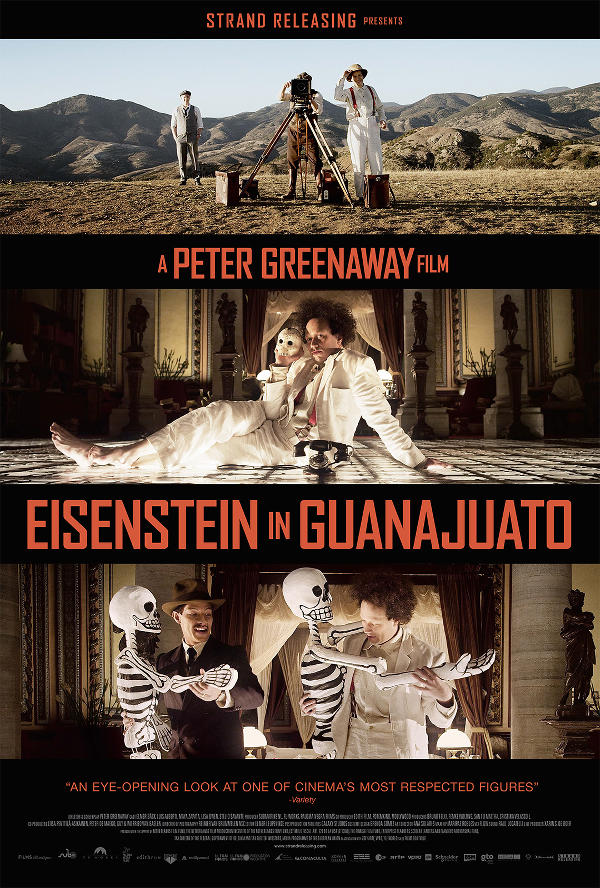
Eisenstein in Guanajuato - A New Film by Peter Greenaway
(2015, 105 minutes)
Tuesday, March 1, 7:30 p.m. Thursday, March 3, 7:30 p.m. Tuesday, March 8, 7:30 p.m.
In 1931, at the height of his artistic powers, Soviet filmmaker Sergei Eisenstein traveled to Mexico to shoot a new film to be titled ¡Que viva México! Freshly rejected by Hollywood and under increasing pressure to return to Stalinist Russia, Eisenstein arrived at the provincial capital city of Guanajuato. Chaperoned by his guide Palomino Cañedo, he vulnerably experienced the ties between Eros and Thanatos, sex and death, happy to create their effects in cinema, troubled to suffer them in life.
Peter Greenaway's latest film explores the mind of a creative genius facing the desires and fears of love, sex, and death through ten passionate days that helped shape the rest of the career of one of the greatest masters of 20th-century world cinema.
An international co-production of the Netherlands, Mexico, Finland, Belgium, and France. In English and Spanish with English subtitles. These public nontheatrical screenings are presented by arrangement with Strand Releasing.
PROGRAMMER'S NOTE: "I am personally thrilled to be screening this new Peter Greenaway film in Buffalo less than a month after its opening in NYC on February 4, 2016, a film too transgressive—and maybe also too "arty," to quote the NY Times—for a theatrical release in Buffalo, luckily for us, for THREE exclusive screenings in Hallwalls Cinema in early March. Besides being a devotee of both Eisenstein and Greenaway (and Mexico!), I happened to stumble upon and (unknowingly, until after the fact) to photograph Greenaway himself filming a sequence of the film in the streets of Guanajuato City on a day trip there with Cheryl Jackson, Wendy Huntington, and Richard Huntington two years ago, on February 19, 2014. I will share location photos and a short video I shot of the sequence being filmed on Hallwalls' Facebook page" (Ed Cardoni).
Stephen Holden's review of the film in the New York Times, 2/4/16:
Sex and death, or in the elevated language of the British director Peter Greenaway "Eros and Thanatos," walk hand in hand in Eisenstein in Guanajuato. This comedic fantasy from Mr. Greenaway about the seminal Russian filmmaker Sergei Eisenstein's trip to Mexico in the early 1930s quotes Eisenstein at length, while imagining a scandalous personal life, about which little is known. Referring to his classic film October: Ten Days That Shook the World, Eisenstein calls this working vacation "the 10 days that shook Eisenstein."
As embodied by the Finnish actor Elmer Bäck, Eisenstein is a roly-poly, motor-mouthed clown with a mop of wiry hair and body-image issues. His raucous behavior recalls the Italian comic Roberto Benigni on a tear. In certain shots he resembles the comedian Billy Crystal, and in others the fitness guru Richard Simmons.
The movie gleefully demolishes the cliché of a great artist as a brooding, omniscient eminence. Not since Ken Russell's screen biographies of painters and composers (The Music Lovers) has a director deconstructed the myth of the heroic creator with such merciless delight. In Eisenstein in Guanajuato, Mr. Greenaway (The Cook, the Thief, His Wife, and Her Lover) goes to lunatic extremes Russell himself rarely approached.
Beyond the arty trappings and flamboyant showmanship that are typical of Mr. Greenaway, 73, Eisenstein in Guanajuato is a brazen provocation that focuses on the Eisenstein character's embrace of his homosexuality while in Mexico. Shortly after arriving there from Los Angeles, his virginity is taken by his handsome Mexican guide, Palomino Cañedo (Luis Alberti), a married philosopher of comparative religion with two young sons. Physically painful though his initiation is, Eisenstein quickly embraces homosexuality as the path to ecstasy and falls in love. As he puts it, "I had to come to Mexico to go to heaven."
Like few films not marketed as pornography, Eisenstein in Guanajuato revels in male full frontal nudity and unblinkingly observes the naked Eisenstein's defloration from a middle distance. Eisenstein frequently talks to his penis and laments the lumpy shape of his own body, which Palomino assures him isn't unattractive. After one encounter, Palomino ceremoniously plants a miniature Soviet flag between Eisenstein's buttocks. Such scenes suggest that the film is partly intended as a deliberate affront to Vladimir V. Putin's Russia, where Eisenstein is celebrated as a cultural deity and homosexuality officially despised.
Eisenstein's trip to Mexico, by way of Hollywood, to make a film, ¡Que viva México! was funded by the American muckraking novelist Upton Sinclair (The Jungle), whose wife, Mary Craig Sinclair (Lisa Owen), appears in the film as a frivolous, snobbish caricature offended by Eisenstein's cheeky disregard for conventional manners.
Embroidering the love story is a densely allusive biography of Eisenstein, who had completed at least three silent films —Strike, Battleship Potemkin, and October— before his Mexican sojourn. The film includes clips from his silent movies, accompanied by a live orchestra playing Prokofiev's majestic Fifth Symphony. There are no scenes of him making ¡Que viva México!, for which he shot 250 miles of footage that he could not retrieve before he was ordered to return to Russia.
In Mr. Greenaway's heavily researched screenplay, Eisenstein expounds on film theory, the grimness of Russian life, and Hollywood, often in his own words, and drops the names of countless famous artists. The palette arbitrarily alternates between black and white and color. Many images are divided into triptychs. When Eisenstein ventures out of his hotel, he visits the city's famous El Museo De Las Momias (The Mummies' Museum), and after the news of a catastrophic mudslide, goes to the disaster scene and is traumatized by the death of a child in his arms.
As the movie goes along, Thanatos increasingly wins out over Eros. Images of skeletons and Jesus's crucifixion multiply. Eisenstein and Palomino appear masked and dressed as skeletons to do a dance to celebrate Mexico's Day of the Dead. Eisenstein's heart is broken and his film unfinished. He must return to Stalinist hell.