To learn more about the benefits of becoming a member, please click here.
Eva Hesse - Encore Screening
A film by Marcie Begleiter
(2016, 108 minutes)
"I am interested in solving an unknown factor of art and an unknown factor of life."
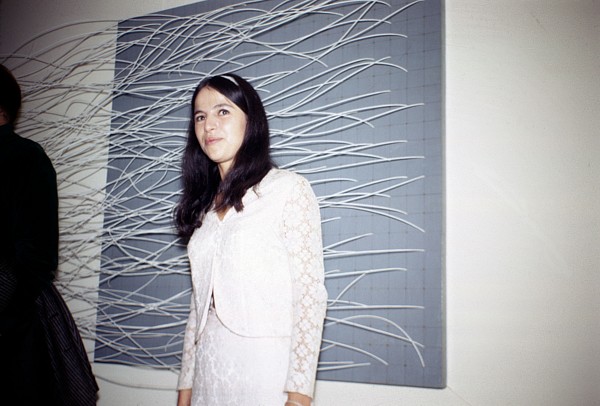
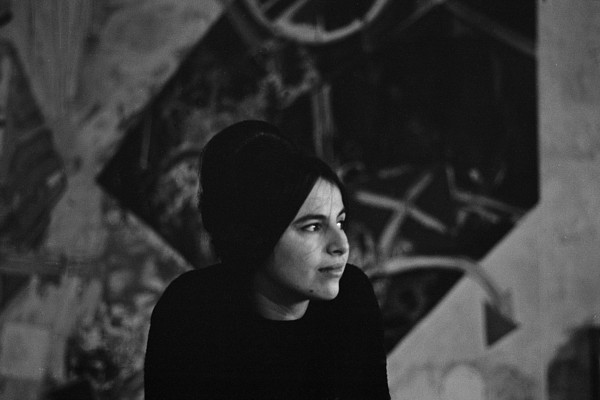
From the beginning, Eva Hesse's life was marked by drama and social challenges. Born in Hamburg in 1936 to a German-Jewish family, the artist's fierce work ethic may have developed from a complex psychology that was formed, in part, as a Jew born in Nazi Germany. Having escaped the fate of her extended family, Eva and her older sister Helen were sent out on one of the last Kindertransports (trains that carried Jewish children to safety) and was eventually reunited with their parents in Holland. They made their way to New York in 1940 but her family struggled to make a new home. When Eva was 9 her mother, after many years of depression and a failed marriage, heard about her own parents' demise in the concentration camps and committed suicide. The remaining years of Hesse's youth were difficult, but she discovered herself as an artist early in life. The passion and serious attention she gave TO her studies supported her later successes.
The artist graduated from Cooper Union and Yale School of Art, then returned home to Manhattan in late 1959 and began to receive attention for her highly original, abstract drawings. In 1961 Hesse met Tom Doyle, an already established sculptor, and in a whirlwind romance married him a scant 6 months after first glimpse. Their relationship was both passionate and competitive. Hesse struggled with the desire to be on equal footing with Doyle in terms of their art making, but also wanted to be in a marriage with someone who could offer her the security that life had often denied.
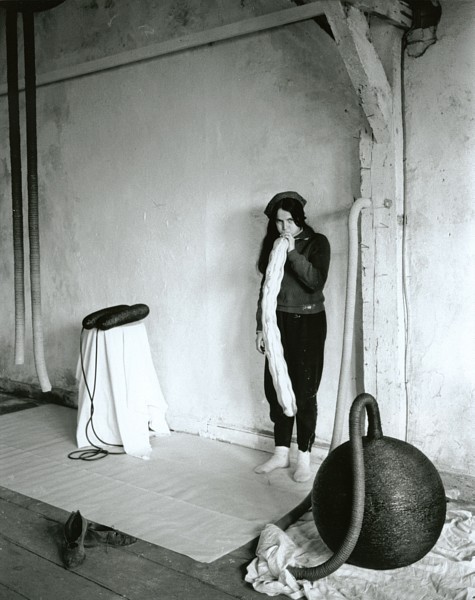
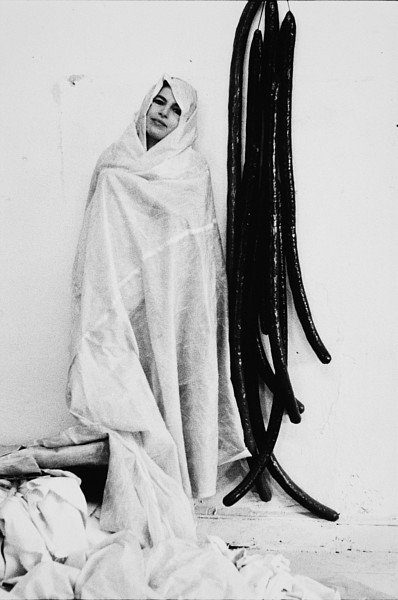
In 1964 Friedrich Arnhard Scheidt, a German industrialist, offered an all-expenses paid artist's residency to Tom Doyle for year of working in an abandoned textile factory near Essen, Germany. It was tough choice for Hesse - go back to the country that had murdered her family or stay in New York and work menial jobs while trying to make art with any time and energy left over. Ironically, the work on which her reputation was built began to emerge during this extended visit to the homeland she had escaped 25 years earlier. When the couple arrived for the residency, Doyle was clearly the artist of note. But something happened during those 14 months in the cold factory on the Ruhr River. Eva arrived in Germany a painter. But as she worked in the thin German light, she began to incorporate pieces of metal and string that she found in the corner of her studio into her work. By the time the couple were ready to return to New York in the fall of 1965, Eva had fully incorporated a 3-dimensionality into her work which was now neither painting nor sculpture, but an exciting cross-breed of the two. And people were beginning to take notice. Within months after returning to New York in the fall of 1965, her work was thriving but the marriage failed. Tom moved into his studio just across the Bowery.
For the next five years, Eva worked non-stop on an impressive body of work, completing dozens of major sculptural works and hundreds of works on paper. Although she sold little, critical attention was paid and she was showing often and in excellent venues. She was also offered a teaching position at the School of Visual Arts in Manhattan. In 1969 Hesse began having debilitating headaches and was diagnosed with a brain tumor. Although her operation was deemed a success, the tumors reappeared and she died in 1970 at the age of 34 the same month that that her work was on the cover of ArtForum. A memorial retrospective filled the entire Guggenheim two years later and solidified Hesse's place in art history as one of the century's most significant artists.
"CRITIC'S PICK. A major artist… (A) conscientious and moving documentary (that makes) ample and judicious use of Hesse's letters and diaries… Among her closest confidants was Sol LeWitt… Their correspondence is clearly a remarkable trove of art world gossip, fraternal feeling and critical insights, and it provides this film its emotional and intellectual grounding. A story of mastery and self-discovery. Conveys a vivid sense of the sexual politics of the New York art world in the 1960s. An indispensable aid to understanding and appreciating a fascinating artist." — A.O. Scott, The New York Times
"ONE OF THE 6 MOVIES YOU CAN'T MISS THIS MONTH. It's in tracing how a woman finds her own distinctive voice in an art world full of men so assured they'd be taken seriously that the film really comes into its own, reverberantly depicting how Hesse went from the side room and the supportive role to being the one who was in the spotlight, however briefly." — Alison Wilmore, Buzzfeed
"Hesse had one of the 20th century's more compelling life stories. A charismatic figure… she has inspired passionate adoration. She successfully synthesized the newly ascendant minimalist and serial tendencies with a witty form of eccentric expressionism and a subversive use of new materials… She shook up categories, produced ambitious works charged with pathos and wit - but like Vincent Van Gogh or Henri Toulouse-Lautrec, or more to the point, fellow neurotic and alienated Jew Franz Kafka, her art cannot be separated from her biography." — J. Hoberman, Tablet
DIRECTOR'S STATEMENT by Marcie Begleiter
I have an abiding interest in the art and life of Eva Hesse. The work moves me deeply in the mysterious way that powerful art can function. It's hard to categorize; inhabiting a space that moves fluidly between media and ideas. The work made me want to know more about the artist and that led to Lucy Lippard's "Eva Hesse", the first book written on the artist after her early death in 1970. This volume includes fragments from Hesse's unpublished journals and the single audio interview she gave in her lifetime.
I connected strongly with the voice and heart that came through in these short quotes and began to search out more material from Hesse's archive. Like Eva, I also have roots in the European Jewish community, a history that comes with many opportunities as well as inherent challenges. The female perspective is also very strong in her writing as is her ambition and bravery.
No biography in English has been published, so I decided to go visit those unpublished journals at the Allen Art Museum in Oberlin, Ohio where they are housed. Given a pair of white gloves, I sat for a week in their rare manuscripts library, reading through hundreds of pages. The journals told a deep and compelling story about this remarkable woman's journey. It was characterized by loss, but more importantly for me, by a triumphant commitment to work and living life to its fullest. By week's end I had fallen for the woman as I had for the work and began a series of projects of which this film is the latest incarnation.
Using Hesse's writings as inspiration, I wrote the theatrical work "Meditations: Eva Hesse" which was co-produced by Highways Performance Space in Santa Monica, CA during their 2010 season. The play was well attended, and Karen Shapiro (one of the films producers) approached me about taking the play to a larger venue. With that in mind, and wanting to reach out to Hesse's estate, in 2011 I conducted a series of audio interviews with the artist's family and friends.
Their passion for Eva, a woman gone for over 40 years, and their insights into her life and times was so deeply engaging, I sensed there was another project to be developed based on the material. I also realized that given the age of Eva's family and colleagues, this idea needed to be moved upon sooner than later. I called Karen to ask if she would like to produce a film in lieu of the play and before I could get the words out she said "I know what you are going to say: You want to make a documentary." I was astounded. "How did you know?" She said, "I saw it in my meditation this morning." So the producing team was together from day one.
There was a chance that a documentary had already been made so I called Helen Hesse Charash, Eva's sister and head of the estate. She told me there had been interest, but none had been produced. Given Hesse's importance in the art world and her incredible life, I was surprised and asked her if we might go ahead and try to do it. She immediately said 'Go for it!" That 'yes' has propelled the last 5 years, through the most intense and rewarding professional experience of my life.
"Eva Hesse" is a film that is a personal culmination of the work that has been informed by this remarkable artist; her art and her world. Along with the dozens of talented and dedicated collaborators, we have worked in concert to create a work of that reflects Eva's beauty, intelligence and power; a fitting tribute to this extraordinary artist.
Marcie Begleiter - Director
Director Marcie Begleiter has been researching and writing about Eva Hesse for a number of years. She authored the play "Meditations: Eva Hesse" and directed the short "Eva Hesse, Walking the Edge" for the Hamburger Kunsthalle in 2014. Her book "From Word to Image: Storyboarding and the Filmmaking Process" is a bestseller and she is recipient of grants from the NEA, the Durfee Foundation and the Foundation for Arts Resources. This is her first feature documentary as director.
Karen Shapiro - Producer Producer Karen Shapiro's films include the film festival hit "Beat the Drum", the romantic comedy "The Neighbor", the drama "The Low Life" and the Academy Award winning short, "Violet". Her television work includes the Emmy Award winning "Other Mothers" and "Between Mother and Daughter", winner of the Humanitas Award. Two of her documentaries, "Awake and Sing" and "Together As One" were produced for a benefit concert that commemorated the 50th anniversary of the end of Nazi-occupied Europe.
EVA ON ART AND LIFE Quotes excerpted from Hesse's Journals (late 1950s—1970) and Cindy Nemser interview (1970)
"I am interested in solving an unknown factor of art and an unknown factor of life."
"Art is the easiest thing in my life, and that's ironic. It doesn't mean I've worked little on it, but it's the only thing I never had to. That's why I think I may be so good. I have no fear."
"My life has been so traumatic, so absurd, there hasn't been one normal, happy thing. I'm the easiest person to make happy, and the easiest person to make sad because I've gone through so much. And it's never stopped."
"For me, it's a total image that has to do with me and life. It can't be divorced as an idea or composition or form. I don't believe art can be based on that. This is where art and life come together."
"I'm very complex, I'm not a simple person, and the complexity - if I can name what it consists of is the total absurdity of life."
"I remember always working with contradictions and contradictory forms, which is my idea also in life. The whole absurdity of life, everything for me has always been opposite. Nothing has ever been in the middle."
"I've been a giant in my strength and my work's been strong and my whole character has it inside. But somewhere I'm a terribly frightened person."
"My life has never had anything normal or in the center. It was always extremes. And I think, and I know that, in forms that I use in my work, that contradiction is certainly there."
"But my right or wrong isn't to have a pure or fine edge. I do think there is a state, a quality, that is necessary, but is not based on correctness. It has to be based on the quality of the piece itself. That hasn't to do with neatness, not artisan quality for the sake of craft."
"I have very strong feelings about being honest, also heightened since I have been so ill. I'd like to be true to whatever I use and use it in the least pretentious and most direct way."
"This is what I want to be, the most Eva can be as an artist and as a person."
"What makes a tight circle or a tight little square box more of an intellectual statement than something done emotionally, I don't know."
"Art is an essence, a center."
"I think the circle is very abstract. I could make up stories of what the circle means to men, but I don't know if it is that conscious. I think it was a form, a vehicle."
"I wanted to get to non-art, non-connotive, non anthropomorphic, non geometric, non, nothing. Everything, but of another kind, vision, sort."
"How to achieve by not achieving? How to make by not making? It's all in that. It's not the new, it is what is yet not known, thought, seen, touched but not really what is not. And that is."
"Excellence has no sex."
"Do I have a right to womanliness? Can I achieve and artistic endeavor and can they coincide?"
"When an artist is successful, it represents a lot in society."
"What drives us to work? It seems to me some kind of recognition which maybe we cannot give to ourselves. One should be content with the process as well as the result. But I am not!"
"I have really been discovering my weird humor, maybe sick or maybe cool but I can only see things that way. Experience them also, but I can't feel cool - that is my hopelessness."
"How do you believe in something deeply? How is it one can pinpoint beliefs into a single purpose?"
"I don't mind being miles from everybody else. The best artists are those who have stood alone and who can be separated."