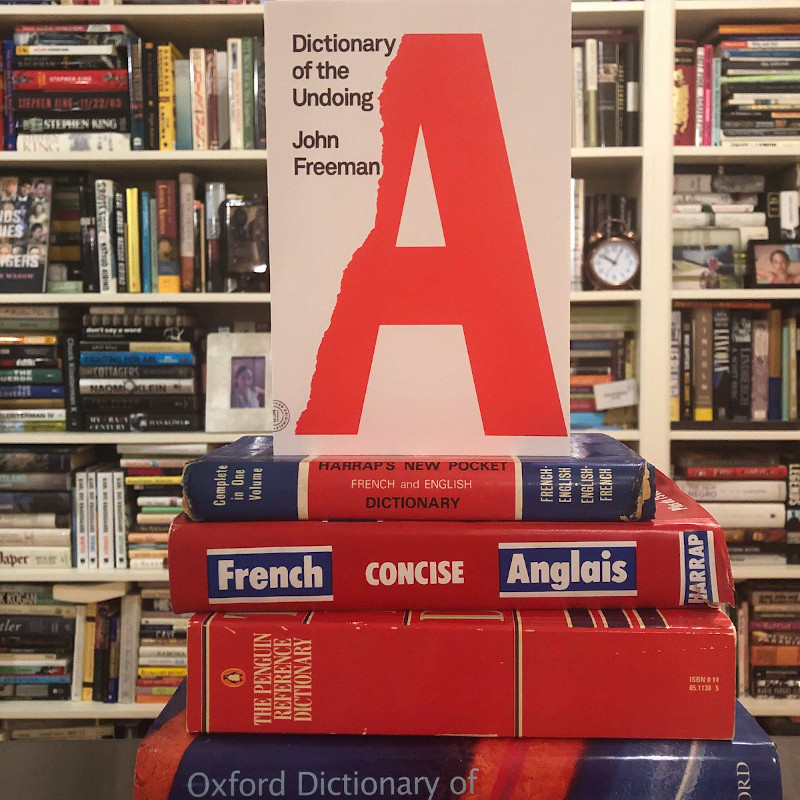
Poet, Editor, & Critic Discussing his new book, Dictionary of the Undoing (MCD x FSG Originals)
With a panel of local citizens including Rahwa Ghirmatzion of PUSH Buffalo and Eric Gansworth of Canisius College, to be moderated by Sam Magavern of the Partnership for the Public Good.
This event is free and open to the public. Books will be available for purchase on site or in advance at Talking Leaves. Purchase of a book is encouraged as an act of support and respect for the author, his publisher, the panelists, and the organizations sponsoring and hosting the event.
For John Freeman—literary critic, essayist, editor, poet, and "one of the preeminent book people of our time" (Dave Eggers)—it is the rare moment when words are not enough. But in the wake of the election of 2016, words felt useless, even indulgent. Action was the only reasonable response. He took to the streets in protest, and the sense of community and collective conviction felt right. But the assaults continued—on citizens' rights and long-held compacts, on the core principles of our culture and civilization, and on our language itself. Words seemed to be losing the meanings they once had, and Freeman was compelled to return to their defense. The result is his Dictionary of the Undoing.
From A to Z, "Agitate" to "Zygote," Freeman assembled the words that felt most essential, most potent, and began to build a case for their renewed power and authority, each word building on the last. The message that emerged was not to retreat behind books, but to emphatically engage in the public sphere, to redefine what it means to be a literary citizen.
"How to be good in bad times? How to speak truth? Why read? Why write? Why bother? It is a symptom of our ongoing catastrophe that such questions must be asked, but we're lucky that John Freeman is out there looking for some answers. Language is Freeman's primary concern, and in Dictionary of the Undoing he sets out to reclaim it and restore what was damaged by an onslaught of evil and idiocy."
~ Aleksandar Hemon
Dictionary of the Undoing is a necessary, resounding outcry in defense of language, meaning, and our ability to imagine, describe, and build a better world. In her afterword, Valeria Luiselli says "it is a book that makes you think, then rethink. It invites you to engage with it, to refute it, to contribute to it." Our panelists will do just that, engaging with the author and audience around the issues of language and activism and citizenship that are a focus of his book, a call to assume the same greater stewardship for our language and its uses that we must for the planet.
Rahwa Ghirmatzion left Eritrea with her family as a refugee when she was eight. Her family settled in Western New York. Educated in Buffalo's public schools, she has spent her career working with community-based organizations that promote community development. She was executive director of Ujima Company Inc. and has been, since 2018, Executive Director of PUSH Buffalo.
Eric Gansworth (Onondaga, Eel Clan) is a writer and visual artist, born and raised at the Tuscarora Nation. He has written award-winning novels for adults and young adults, a collection of poems and paintings, and a play selected for the Public Theater's Native Theater Festival. He is Professor of English and Lowery Writer-in-Residence at Canisius College.
Sam Magavern serves as senior policy fellow at Partnership for the Public Good, which he co-directed or directed since its founding in 2007 through 2018. He teaches at the SUNY Buffalo Law School and the Cornell University ILR School. A writer, his publications range from scholarly articles to comic books, including a non-fiction book, a novel, a movie, and a book of poetry.
John Freeman is the editor of Freeman's, a literary annual of new writing. His books include How to Read a Novelist and The Tyranny of E-mail, as well as Tales of Two Americas, an anthology about inequality in the United States today, and Maps, a collection of poems. His work has appeared in The New Yorker, The Paris Review, and The New York Times. The former editor of Granta, he is Artist-in-Residence at New York University.