


Saturday, June 10, 1989 — Friday, July 28, 1989
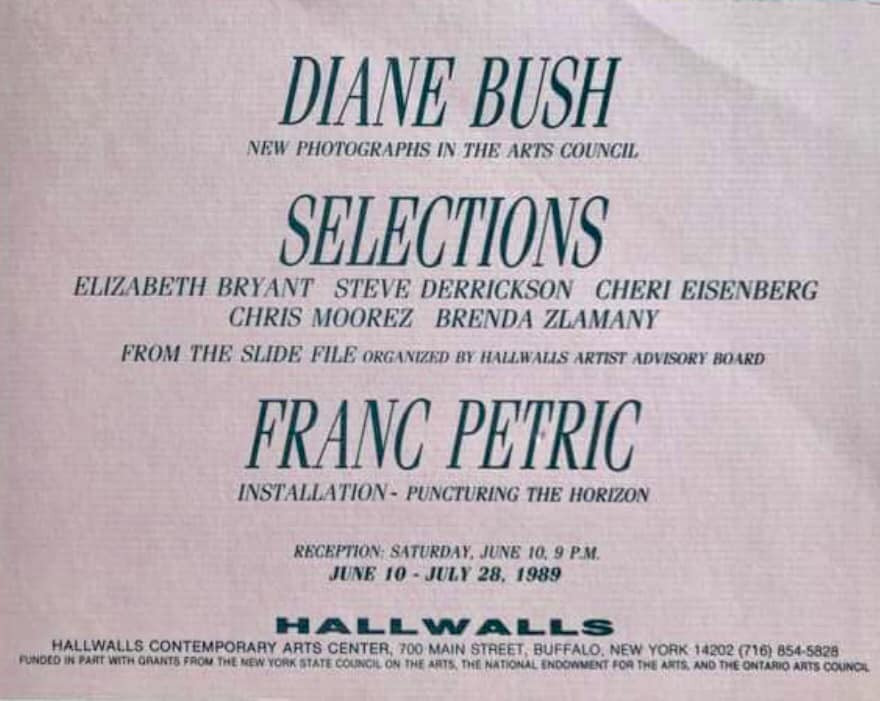
An installation of sculptures with holograms by St. Catharines, Ontario artist Franc Petric.
Franc Petric’S “HORIZON” INSTALLATION SUGGESTS A BOUNDLESS WORLD. Richard Huntington, Buffalo News, July 21, 1989
CANADIAN ARTIST Franc Petric has produced a thoughtful if slightly ominous installation called Puncturing the Horizon. The room-size piece is on view at Hallwalls [700 Main Street, 4th floor] through next Friday [July 28, 1989].
During the past year Petric developed a series of holograms, five of which are at the core of the installation. The artist uses these three-dimensional images as a point of technological reference—an extreme of image-making techniques. Against this extreme he sets the idea of "picture" by placing each hologram in an ornate frame and labeling it with a blank title plate made, incongruously, of thick steel.
To carry the idea of "artmaking" further, each frame is surrounded by an elaborate assemblage of wood, steel, and random industrial scrap. Made of muted but rough non-art materials, these assemblages mimic the expressive-abstract vein of sculpture popular in the late '50s. So what we encounter here are five bulky, boxlike constructions projecting awkwardly from a dark green wall.
The room is dim, with only tiny white lights to illuminate these massive objects. But it is enough white light to reveal the holograms. They glow oddly in their antique frames, straining to assert their technological superiority. A range of artmaking technology is represented here, from the plain assembling of found materials—a process that surely goes back to primitive times—to space-age laser photography. But none of these technologies dominates, and in context even the holograms seem to have the smell of antiquity.
The nature of the objects depicted in the holograms helps this feeling that the new is already old. They are far from high-tech. Like the frames around them, they have the feel of "artistic" constructions, but of a much more casually assembled variety. All of the holograms mix natural and man-made objects. The first is an apple—although it's difficult to identify it as such—wrapped in wire. The second is a ring of snakeskins arranged like a wreath. The third shows a delicate fox skull that has been interlaced with lengths of IV tubing. The next, the most indistinct image, is a conch shell surrounded by industrial mesh, as though trapped. And the last shows tongs inexplicably holding a bone, a gesture that seems at once banal and significant.
As provisional as these objects seem, all appear—thanks to their holographic form—as rarefied experiences. The luminous green, cold blue, bronze, and glowing red-pinks of these images add to their special status in the darkened room. By comparison, the brownish "art objects" appear like things from an ancient and defunct history. Finally, the holograms seem half-science, half-ritual. Although on the face of it we have meaningless combinations of objects, the images are such compelling illusions that they force a string of associations—most of which are vaguely uncomfortable.
To reinforce this discomfort, Petric has given the installation a kind of sentinel figure on the gallery floor proper. A musical instrument—a distorted bassoon, perhaps—is mounted on a surveyor's tripod, and the whole ensemble is set in a heap of rock and dirt. The opening of the horn looks toward the holograms like a watching eye. Like the frame assemblages, this separate construction has a certain fake, arty style that refers to everything from found-object sculpture (especially Robert Rauschenberg's objects) to earth art. The horn/tripod might stand for the "viewer" surveying the "pictures" represented by the holograms and their elaborate framing. In any case, this strange construction allows a symbolic completion of the communication conduit as Tolstoy saw it: from creator to object to receiving mind.
But with Petric, this communication is always on the verge of being broken, and is always hesitant and questioning. Puncturing the Horizon is a somber reverie on the failure of illusion in a technological world. It is about the inability—or unwillingness—to sort out where one form of imagery begins and another ends. Petric's installation suggests a boundless world where nothing can be attached to tangible events, where nature and culture merely intrude upon one another, never resulting in anything like a synthesis. Still, the installation is not so didactic as to spell out such ideas. Though Petric has a firm conceptual framework at the start, he eventually lets his materials determine many of the final effects of his work. Puncturing the Horizon works by suggestion and—odd word that it is today—mood. It's fully possible to appreciate this work by soaking up its impressive ambiance.