some image
341 DELAWARE AVE. BUFFALO, NY 14202
t: 716‑854‑1694  f: 716‑854‑1696


GALLERY HOURS:
Tuesday–Friday 11:00am–6:00pm

Saturday 11:00am–2:00pm.

Literature Program
 

Friday, February 5, 2016 — Saturday, February 6, 2016 at 7:00 p.m.

$15 general admission, $12 students/seniors, $10 members

To learn more about the benefits of becoming a member, please click here.

Road To Nowhere

The Ninth Ward @ Babeville

A Brief & Personal History of Alternative Space in the 80s & 90s written & performed by Ron Ehmke

$15 general, $12 students/seniors, $10 members
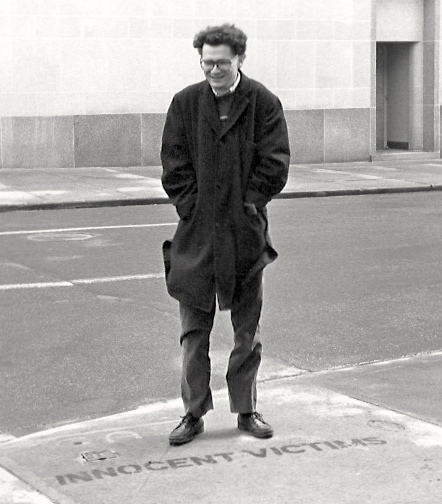
Photo credit: William Mondlak.

A site-specific event for Hallwalls Contemporary Arts Center
based on the monologue trilogy The Dark Times
With new, never-performed-before material


Featuring dance music from the 80s & 90s from DJ Paul Szp and visuals by VJ Ron D M Key

7-8 pm: DJ set
8-9:30 pm: Road to Nowhere
9:30-11 pm: DJ/VJ set

"[Ehmke] is an enormously likable and funny guy, with an uncanny ability to lock eyes with his audience and hold its attention as he delivers a message that is both sage and frightening. He is, in short, the real thing, an artist among us." — Patricia Donovan, The Buffalo News, 1997

Ron Ehmke is a writer, performer, and media artist with more than 40 years' experience making and writing about art of many kinds. Since 1982, he has made Western New York his home.

In the 1980s and early 1990s, Ehmke was both an observer of and a participant in the fabled Second Golden Age of Hallwalls Contemporary Arts Center. During that period he served as curator of the gallery's Performance program, bringing more than a hundred performing artists from around the world to Buffalo. Some later garnered international acclaim; three—Karen Finley, Holly Hughes, and Tim Miller—became the unwitting objects of widespread notoriety when they were branded three quarters of the "NEA 4," artists singled out by right-wing legislators for creating "immoral" art (in those days, however, it was the word "art" that was put in quotes in the halls of Congress and the pages of newspapers and magazines). In 1988, Ehmke was instrumental in launching the long-running Ways In Being Gay festival, borne of the AIDS crisis and ACT UP, the rise of New Queer Cinema, and a new post-Stonewall generation of artists and activists.

After seven years working late into the night at a not-for-profit art gallery (where incomes at the time averaged out to less than minimum wage, while the true compensation came from the employees' passion for the art they helped nurture, the ability to function in a non-hierarchical environment, and the lifelong friendships they made with like-minded artists and audience members), Ehmke intentionally shunned full-time employment from then on and became what one friend called a "cobbler" in the mid-1990s, cobbling together a living from grants and honoraria received for his performance and video work (including SNAP JUDGMENTS, a cable access series and proto-podcast he created with part-time artist/part-time paralegal Richard Wicka) and a variety of arts-related day jobs.

He became a freelance reporter covering the independent film, visual art, literature, and theater and LGBT culture of the mid-1990s for a variety of publications from Buffalo's daily newspaper to fine-art journals to college-rock magazines to a MOMA artist's book for photographer Robert Flynt to MTV's early experiment in online journalism, among others. At the same time he worked as Minister of Communications for the DIY record label Righteous Babe Records, founded by Buffalo-based singer/songwriter/guitarist Ani DiFranco, who was rapidly rising from the folk festival and college circuit and the pages of pre-internet zines to sold-out shows at Carnegie Hall and the cover of SPIN in an era when what became branded "alternative music" was all the rage. In 1995, he was commissioned by Hallwalls to edit a book in honor of the organization's 20th anniversary, which he named CONSIDER THE ALTERNATIVES.

Ehmke reflected on all of this—working at Hallwalls, writing a book about working at Hallwalls, writing unsigned press releases for DiFranco which then ran as articles about her credited to other authors that the clipping service returned to him as fodder for future press releases, and much more—in The Dark Times, a 3-night, 5 ½ - hour trilogy of interconnected monologues he wrote and performed around the U.S. in the mid- to late-1990s about the intersections of art and money, among other subjects.

In 2013 he was invited to perform the first part of The Dark Times—Not For Profit: A Personal History of Peripheral Art, 1972-92 at the university in his hometown in Louisiana where the story begins. Revisiting the long-abandoned monologue after more than two decades convinced him to revise, update, and restage the entire project for a new generation of audience members, low-paid artists, and arts administrators at tiny artist-run organizations in a newly revived Buffalo. That new version will be staged by the New Phoenix Theatre during its 2016-17 season, but in the meantime, Ehmke is presenting Road to Nowhere: A Brief & Personal History of Alternative Space in the 80s & 90s at Babeville, the arts complex that is now home to Hallwalls and owned and operated by DiFranco and Righteous Babe.

Road to Nowhere is akin to a found-art collage or a DJ remix of an earlier song, in which material from The Dark Times is lifted out of its original context (the main narrative thread that unites the three monologues will be excised, for instance) and joined by other elements both old and new, shifting the focus to an examination of "alternative space" as that abstract notion was forged in the 1960s and 1970s and ultimately commodified in the 1990s.

Speaking of DJs, Ehmke is inviting musician and artist Paul Szpakowski, a prominent figure in the vibrant art and music scene of Buffalo in the 1980s, to provide dance music before and after the monologue. "Paul Szp," as he is often known, will be playing tunes created by local artists of the era as well as some of the music of the period that has largely been forgotten in the mythology of "I Love the 80s" and related nostalgia. In the second DJ set, Ehmke will be reviving his popular DJ persona, Ron-D.M. Key, as a new-school VJ. After a lengthy side career performing in Buffalo, New York City, and Boston, at venues including the Albright-Knox and PS 122, D.M.Key was last seen fielding requests for "Achy Breaky Heart," the song made famous by Miley Cyrus's father, at a golf banquet in the early 1990s.

For more information on Ron Ehmke's work, visit www.everythingrondoes.com.