publications
 
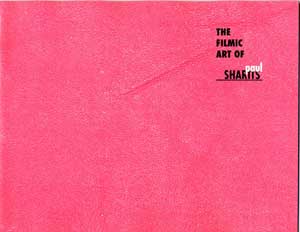
THE FILMIC ART OF PAUL SHARITS


Published in 2000
Curated by Nancy Weekly
Essays by Charlotta Kotik, Anthony Bannon, John G. Hanhardt

THE FILMIC ART OF PAUL SHARITS Burchfield-Penney Art Center and Buffalo State College, Buffalo, NY, 2000. [A thirty-two page color booklet published in conjunction with the exhibition of the same title. Includes an introduction by Nancy Weekly (Curator, Burchfield-Penney Art Center), the essay "Painter Behind the Celluloid" by Charlotta Kotik (Curator, Brookyln Museum of Art), the essay "Interrogating the Cinematic Apparatus: Notes on '3rd Degree' by Paul Sharits" by John G. Hanhardt (Curator, Solomon R. Guggenheim Museum), and the essay "A Sketch" by Anthony Bannon (Director, George Eastman House). Includes color photos of work by Paul Sharits, a chronology of Sharits' life and work, a checklist of the eponymous exhibition, a film program for the works presented at Hallwalls, and a list of faculty at Burchfield-Penney Art Center. The full exhibition was presented at Burchfield-Penney Art Center February 26-May 21, 2000. The booklet was designed by Karl Scheitheir of SKA Graphics Ltd.]

Artists associated with this publication:
Paul Sharits


Some events connected to this publication:
September 23, 2000 - PAUL SHARITS PANEL DISCUSSION
March 22, 2000 - PAUL SHARITS RETROSPECTIVE:
March 19, 2000 - PAUL SHARITS RETROSPECTIVE:
March 17, 2000 - PAUL SHARITS RETROSPECTIVE:


Hallwalls' Digital Archives were established to enhance public access to cultural content and are intended for noncommercial use only; copyright for any work on these pages remains with the original artists or their estates.
 
341 DELAWARE AVE.
BUFFALO, NY 14202
t: 716-854-1694
f: 716-854-1696

 
GALLERY HOURS:
Tues.—Fri. 11-6
Sat. 11-2
Sun. & Mon. closed

IN THE GALLERY
from May. 17, 2013
through Jun. 28, 2013
 

Jason Seeley
Piles


Jason Seeley is a visual artist working in painting and installation. His work investigates the psychology of survival within contemporary society, and the continuously contradicting battle between liberation and repression, that exists as a mode of being that we all have in common.
 

Esperanza Mayobre
Nada se trata de nada todo se trata de mucho


Esperanza Mayobre creates stories that question problems that in the most part have no answers. The themes that she explores have been those that we generally do not want to talk about. Through narratives of sickness, death, birth, poverty, debt and immigration, among other subjects, she employs a variety of visual formats. Creating works from disparate elements that reflect the compartmentalization and varied nature of our lives.